

Europe/Zurich
ProjectsAugust 22, 2025

Meetique

image
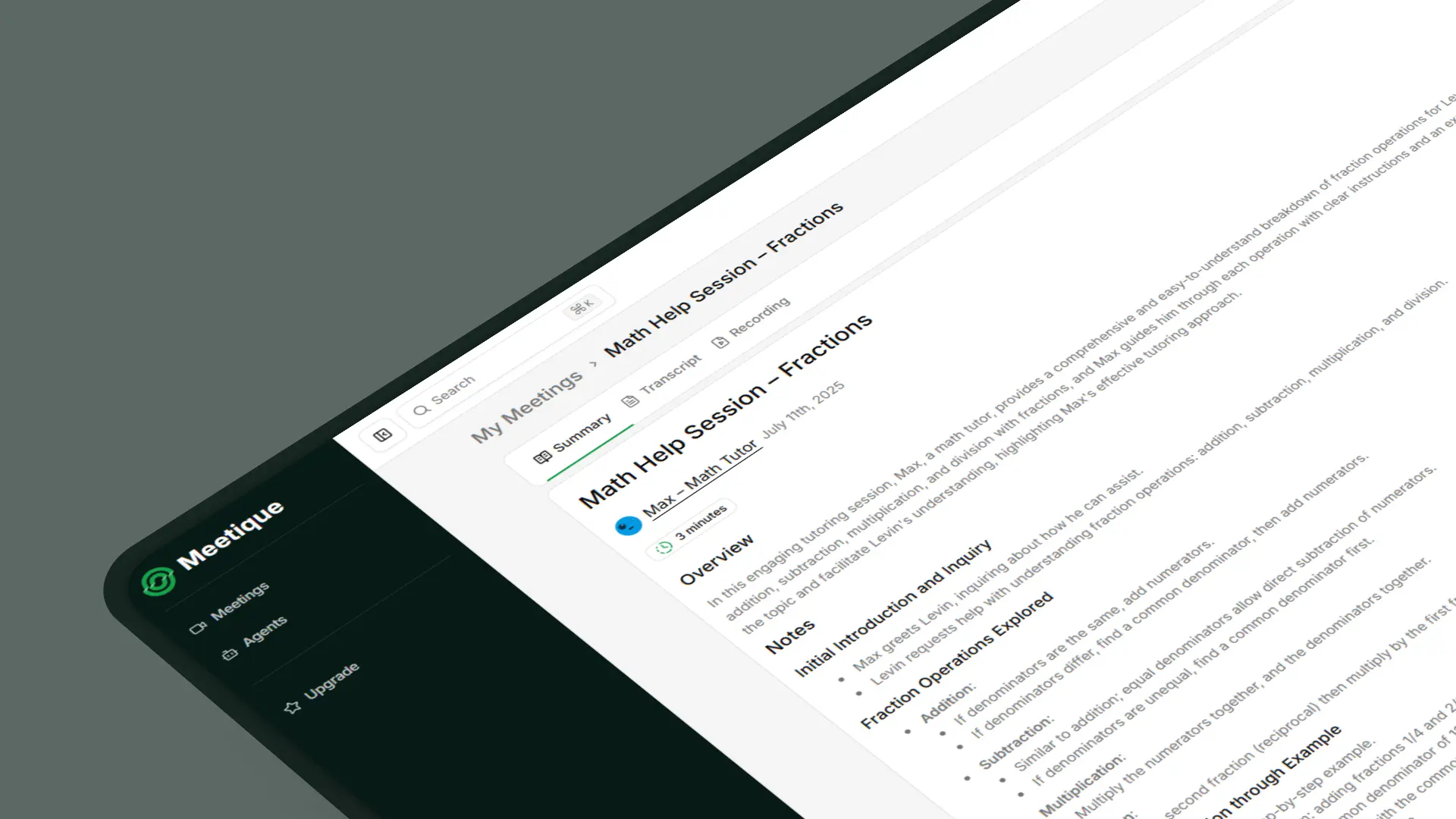
It started with frustration. I was in yet another online study session where half the time was spent clarifying what we’d just discussed, and the other half was lost to distractions. At the end, we all left with fuzzy memories and no clear summary of what had been decided. That’s when the idea for Meetique was born — an AI-powered meeting platform designed to help users stay focused, capture key moments automatically, and leave every meeting with a concise summary.
Real-time video. Intelligent transcription. GPT-4 summaries. A meeting that finally remembers what you said.
Levin BänningerVisit Meetique
The way we meet online hasn’t evolved much. Tools like Zoom and Google Meet connect us, but they don’t help us make sense of what actually happens during the call. For students and professionals alike, that means sifting through recordings, half-written notes, and scattered action points. I wanted something different: a space where meetings are not just recorded — but understood. Meetique lets users schedule and conduct video meetings with custom AI agents that transcribe discussions in real time and generate summaries powered by GPT-4. These summaries don’t just repeat what was said — they distill meaning, decisions, and next steps. For me, it started as a personal productivity tool. But as I built it, it became a reflection of everything I’d learned about designing and developing modern, full-stack web applications. The development of Meetique was a lesson in full-stack design and persistence. I began by sketching out the architecture: how real-time video could coexist with AI-driven transcription, how summaries could be generated without blocking user interaction, and how to ensure the system remained responsive under load. Over two months, I went from early prototypes to a production-ready platform. The stack combined Next.js 15 with TypeScript, tRPC, Drizzle ORM, and Stream Video SDK. Every part was chosen to balance type safety, performance, and developer experience. What I didn’t anticipate was how much I’d learn about system design — authentication flows, secure webhook integrations, and background job orchestration with Inngest quickly became part of my daily vocabulary.
Early Technical DecisionsBuilding a real-time AI app meant combining technologies that weren’t originally meant to work together. I had to orchestrate multiple moving parts — from OpenAI’s GPT-4 API to Stream’s real-time SDK — while maintaining strict type safety through tRPC and Zod.
Challenges Along the WayIntegrating AI summarization was one of the hardest parts. Transcripts had to be processed asynchronously, transformed into structured prompts, and passed through GPT-4 in a way that respected both latency and cost constraints. Each transcript was an experiment in efficiency and precision.
The turning point came when I built the AI pipeline. Instead of summarizing in real time — which introduced lag — Meetique waits until the meeting ends, then triggers an asynchronous background job to process the transcript, identify speakers, and generate structured GPT-4 summaries. This approach ensured that the frontend remained snappy while the backend handled complex workloads quietly in the background. It was my first taste of true asynchronous system design — and the satisfaction of seeing a clean summary appear minutes after a meeting ended was unforgettable.
Every technical constraint hides a design opportunity. The challenge isn’t avoiding limits — it’s shaping them into strengths.
A realization from building Meetique
Meetique runs on Vercel, powered by a PostgreSQL database hosted on Neon. Authentication is handled by Better Auth, analytics via PostHog, and error monitoring through Sentry. Bot protection and rate limiting are enforced with Arcjet, ensuring that the system remains secure even under load. Subscriptions and billing are managed through Polar, while transactional emails are delivered via Resend. It’s a complete, modern web application — built with production standards in mind, but crafted by a single developer. Building Meetique taught me more than any tutorial could. I learned how to reason about data flow in distributed systems, how to design type-safe APIs, and how to integrate AI workflows into existing application logic. More importantly, I learned the art of iteration — how to ship, test, and refine quickly without losing focus on quality. Today, Meetique is a functional AI meeting platform that supports custom agents, secure authentication, real-time video, and automated summaries. It’s both a study companion and a personal milestone — a reminder that complex systems can be built with curiosity, patience, and persistence.
Meetique began as a tool for focus, but it became a framework for understanding how technology can enhance — not replace — human conversation.
Final Reflection
Long term, I envision Meetique as a collaboration platform where every conversation leads naturally to clear outcomes — not just recordings.